

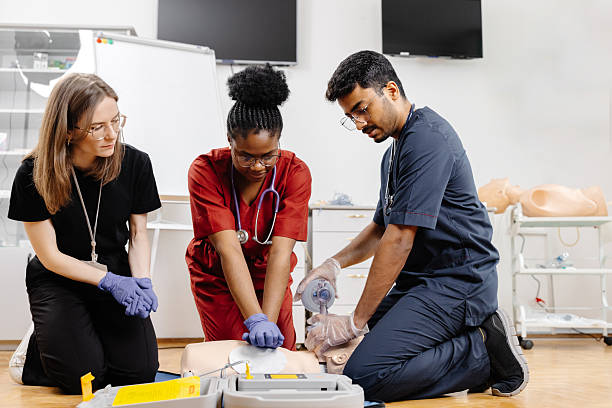
Paediatric emergencies follow different rules than adult ones. Compression depth, rescue breath ratios, and choking protocols all change depending on the age of the child. What works in adult CPR can cause harm when applied to an infant. Yet most general first aid courses spend the bulk of their time on adult scenarios.
That’s the gap a specialist programme fills. Parents, childcare educators, preschool teachers, and sports coaches who work with children aren’t just looking for a general first aid certification in Singapore. They need training that maps directly to the size, physiology, and common emergency types they’ll actually encounter.
The child first aid course in Singapore addresses this directly. The syllabus is built around paediatric scenarios, and the assessment covers infant and child protocols as distinct skill sets rather than as an afterthought.
How Paediatric First Aid Differs from Adult First Aid
Infant CPR Technique
For infants under 12 months, the recommended CPR method uses two fingers on the lower sternum rather than the heel of the hand. Compression depth targets approximately 4 centimetres. Rescue breaths are gentle, just enough to see the chest rise, because overinflation damages infant lungs.
Getting this wrong during actual resuscitation doesn’t just fail to help. It can cause rib fractures or internal injury. Which is why practising the correct technique on infant training manikins is the only way to build reliable muscle memory.
Child Choking Protocol
The choking sequence for a child between 1 and 8 years old differs from both infant and adult protocols. Five back blows followed by five abdominal thrusts, adjusted for the child’s smaller frame, is the standard. For infants, abdominal thrusts are replaced with chest thrusts due to the risk of organ damage.
Here’s what most people don’t realise: the point at which you transition from a conscious choking casualty protocol to an unconscious one, and what you do differently in each case, is a specific skill sequence that requires repeated practice to execute without hesitation.
Medical Emergencies Covered in the Course
Febrile Seizures and Anaphylaxis
Febrile seizures affect roughly 2 to 5 percent of children between 6 months and 5 years. They look alarming but are usually brief and self-limiting. The first aider’s job is to protect the child from injury during the seizure, note the duration, and know when to call for emergency services.
Anaphylaxis is the other high-stakes paediatric scenario. Recognising the signs, triggering emergency services immediately, and understanding when and how to assist with an adrenaline auto-injector are all covered. You won’t be expected to diagnose anaphylaxis clinically, but you will be expected to respond to it.
Wounds, Burns, and Fractures in Children
Children’s skin is more sensitive than adult skin, which affects both wound care and burn assessment. The course covers proportional burn estimation in children, appropriate cooling techniques, and when to escalate to emergency services based on burn surface area and depth.
Who Needs First Aid Certification in Singapore for Child Roles
ECDA-registered childcare educators and infant care staff at licenced centres in Singapore are required to hold a current Child First Aid certificate. The full course satisfies this requirement; the refresher course is for renewals only.
Parents, domestic workers supervising children, sports coaches, school teachers, and camp facilitators also benefit substantially, even when certification isn’t a regulatory requirement. Having someone nearby who can manage a choking infant with correct technique is not a theoretical advantage.
Frequently Asked Questions
What is a child first aid course in Singapore?
It is a paediatric-focused first aid programme that covers infant and child CPR, choking management, febrile seizures, anaphylaxis, burns, and wound care. It is accredited by SRFAC and recognised by ECDA for licenced childcare roles.
How does infant CPR differ from adult CPR?
Infant CPR uses two fingers rather than both hands, targets shallower compression depth at around 4 centimetres, and uses gentler rescue breaths. Ratios and technique adjustments are specific to each age group.
What is the difference between a child first aid course and a standard first aid course?
Standard first aid is primarily calibrated for adults. Child first aid addresses paediatric physiology, age-specific choking protocols, and common emergencies affecting infants and children that don’t appear in adult-focused curricula.
Who needs first aid certification in Singapore for working with children?
ECDA-registered childcare educators are required to hold this certification. Sports coaches, teachers, and parents who want the capability to respond correctly in a paediatric emergency also benefit significantly.
How do I choose a child first aid course provider in Singapore?
Confirm ECDA and SRFAC accreditation, check trainer experience with paediatric topics, and look for courses that use infant and child training manikins rather than only adult models during practical sessions.